
 Exchange
 Sports
 Casino
 Live Casino
 Promotions


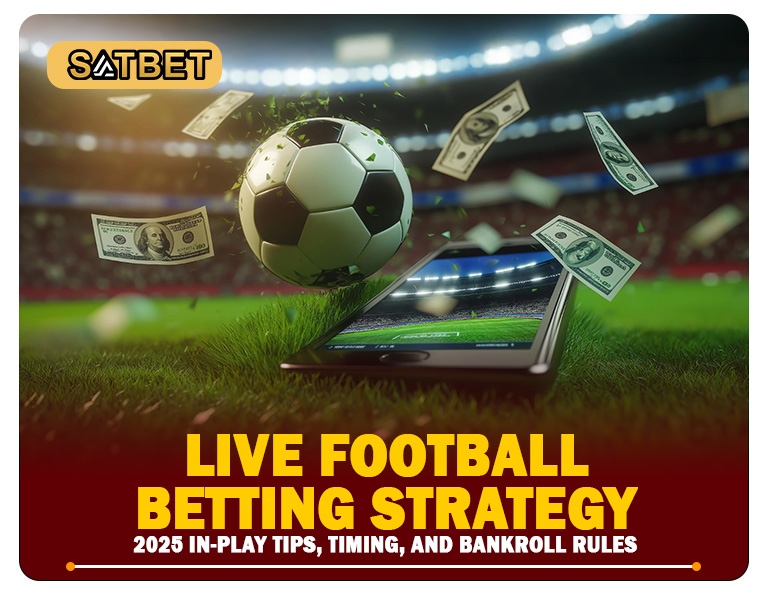
A live football betting strategy works best when you treat in-play markets like changing prices, not predictions. The goal is to spot when odds lag behind what’s actually happening on the pitch—tempo shifts, tactical changes, injuries, red cards, or a team “parking the bus.”
In 2025, most bookmakers update lines fast, so your edge usually comes from specialization: one league, a few teams, or a handful of markets you understand deeply. Also, accept a key truth: you won’t win every session, but you can win long-term if you consistently take prices that are slightly better than the true probability.
Pick the Right Matches for In-Play Betting
A live football betting strategy should begin before kickoff, because match selection is half the win. Prioritize games where live patterns are readable: clear favorites, strong home/away splits, predictable tactics, and reliable team news. Avoid matches with chaotic variance (youth leagues with missing data, poor streams, unknown lineups).
In 2025, you also have richer data—xG models, shot maps, and live momentum stats—so choose fixtures where those signals are available and trustworthy. Finally, watch out for “false pressure”: lots of possession but low-quality chances; it tricks bettors into chasing Over/Next Goal at the worst prices.
Build a Simple Pre-Match Plan
Before you place any in-play bet, outline 2–3 scenarios: “If Team A starts fast and creates big chances, I’ll look for early goal markets,” or “If Team B sits deep, I’ll target unders or delayed overs.” A live football betting strategy should include triggers (what you need to see) and filters (what cancels the bet). Triggers can be: repeated entries into the box, set-piece dominance, a fullback getting cooked, or a coach switching formations. Filters can be: key striker injured, heavy rain slowing play, or a tactical change that kills transitions. This keeps you from reacting emotionally to one shot that clips the post.
Timing: the Biggest Edge Most Bettors Ignore
In live betting, the “when” often matters more than the “what.” A live football betting strategy often uses patience: wait for the market to overreact, then enter at better odds. Example: a favorite concedes early, odds swing hard, but you notice the favorite is still creating high xG chances and pinning the opponent back.
Another timing edge is the “dead zone”: minutes 10–20 and 55–70 often show clearer tactical patterns and fatigue effects, while early minutes are noisy and late minutes are chaos. If you can’t explain why you’re betting now, you’re probably guessing.
Markets that Suit Live Play (and markets to avoid)
A live football betting strategy is stronger in markets where your observation can beat the model—like team totals, Asian lines, next goal (selectively), or unders when a team is protecting a lead with low press intensity. Be cautious with ultra-micro markets (next throw-in, next corner in 2 minutes) unless you have a proven edge; in 2025 those are heavily optimized and fast-settled.
Also, don’t overuse cash-out—treat it as a tool, not a habit. Cash-out can be smart when the match state changes against your thesis (red card, injury, formation shift), but using it purely from fear often locks in bad expected value.
In-Play Strategy Table (quick reference)
Data signals that matter in 2025 (and what’s noise)
A live football betting strategy in 2025 should lean on signals tied to chance quality, not just volume. Shots alone can be misleading; a team can rack up low xG shots from distance and look “dominant” without real threat. Better signals: big chances, xG trend over the last 10 minutes, touches in the penalty area, dangerous set pieces, and how easily a team breaks lines.
Watch for tactical levers too: inverted fullbacks, a winger staying wide to isolate a defender, or a striker dropping to create a midfield overload. Noise signals include possession percentage without penetration, “momentum bars” with unclear methodology, and crowd-driven swings after one flashy run.
Staking and bankroll rules that stop you from blowing up
A live football betting strategy is only as strong as its bankroll discipline. Use flat staking (same unit size) or a small proportional model (like 1–2% of bankroll per bet). Avoid “revenge bets” after a bad beat—live markets tempt you with instant action, and that’s where most bankrolls die.
Decide your daily limit (max bets, max loss) before you start, and stop when you hit it. If you want a slightly advanced approach, only increase stake when your edge is higher (clear mismatch, repeatable pattern, strong price discrepancy), not when you “feel confident.”
Common live-betting mistakes (and how to fix them)
The biggest mistake is chasing odds movement instead of understanding why odds moved. Another is betting after near-misses (“it should’ve been 1–0”), which is pure emotion. Also, many bettors ignore latency: your stream can be behind real-time, and the book might suspend markets during dangerous attacks—by the time you click, you’re paying a worse price. Fixes: pre-select markets, set rules for entry, and write down your reason in one line before placing the bet. If you can’t explain the edge clearly, skip it—there will always be another match.
Make it repeatable: tracking and review
To improve, treat live betting like a system you refine. Track: league, market, minute of bet, odds taken, match state (score, red cards), and why you entered. Review weekly to find patterns: maybe you’re great at unders in low tempo leagues but lose on late overs, or you do well fading early goals but struggle when chasing longshots. This is also where you learn what not to bet. A strategy becomes profitable when you can repeat your best spots and remove your weak ones.
Read More: Who is the No 1 Cricket Captain in the World
Responsible approach and realistic expectations
Live betting can be fun, but it’s still gambling—variance is real, and even good bets lose. Set time limits, don’t bet under stress, and never stake money you can’t afford to lose. If you keep it structured—match selection, triggers, timing, bankroll rules, and tracking—you give yourself the best chance to be consistent. The real “secret” is boring: patience, discipline, and only betting when the price is genuinely wrong.
FAQs
Q1. What is the most successful betting strategy in football?
Value betting with strict bankroll management is usually the most successful long-term approach.
Q2. What is the best strategy for live betting?
Wait for clear match patterns (chance quality + tactics) and enter only when odds don’t match what you’re seeing.
Q3. What is the 1 3 6 2 betting strategy?
It’s a staking sequence using 1–3–6–2 units over four bets (often after wins), but it increases risk and doesn’t create an edge by itself.
Q4. Can live betting be profitable?
Yes, but only with discipline, smart market selection, and consistent value—otherwise speed and variance will beat you.


